You found the house. The offer's accepted. Inspections came back clean enough. Then, ten days before closing, the insurance quote lands in your inbox and it's nearly double what your lender's estimate assumed, or worse, the carrier you wanted simply says no. Not "here's a higher number." No.
That scenario is common enough in Calcasieu Parish that it deserves more attention than it gets. Most guides to buying in Lake Charles lead with the average premium, as if the number on a comparison site tells you what you'll actually pay, or whether anyone will insure the house at all. It doesn't. The real question that decides whether your purchase closes on schedule isn't the average cost of insurance in Lake Charles. It's whether your specific roof, on your specific street, in your specific carrier's underwriting model, qualifies for a policy at all, and at what coverage level.
The average premium is the wrong number to watch
Search for home insurance costs in Lake Charles and you'll get a different answer depending on where you look. One rate analysis puts the average at $3,814 a year for $300,000 in dwelling coverage. Another lands closer to $3,240. A third, factoring in the aftermath of Hurricanes Laura and Delta, puts the range at $4,500 to $6,000 or more. A fourth, using a lower deductible assumption, comes in under $2,500.
That spread is the story. When four legitimate analyses of the same market disagree by thousands of dollars, the average stops being useful and the variables driving the spread become the thing worth understanding: your roof's age and material, your specific zip code's storm history, your credit profile, and which carriers are even willing to write in your area. Two nearly identical houses two blocks apart can carry premiums a thousand dollars apart depending on which side of a rating territory line they sit on.
Here's where it gets more interesting for a buyer. One national rate table lists State Farm's average Lake Charles premium at $4,590 a year, implying it's simply one option among several. A separate industry analysis flags that State Farm generally doesn't offer new coastal homeowners policies in Lake Charles at all. Both can be true. A carrier can post a rate table that includes existing coastal policyholders while declining to write new business in the same zip code. If you're shopping for insurance as a buyer rather than renewing as an existing customer, the number on the comparison site may not be an offer you can actually accept.
Why your zip code decides who will even bid
Louisiana's homeowners market has been reshaping itself since 2020. State regulators report that rate increases have slowed from double-digit annual jumps (16.2% in 2022, 14% in 2023) to closer to 6.6% in 2024, with projections around 4% for 2026. That's genuine progress, but it's progress from a very high starting point, and it hasn't solved the more basic problem in coastal parishes: some carriers simply won't write new policies south of Interstate 10, Lake Charles included.
That's why Louisiana Citizens Property Insurance, the state's insurer of last resort, still carries more than three times the policy count it held before Hurricane Laura. The state has been running "depopulation" rounds to shift Citizens policies back to private carriers, with an assumption date of April 1, 2026 for the most recent round and another planned for December 1, 2026. Here's the part that matters for a buyer: a private carrier picking up a depopulated policy still underwrites the home first, and can decline the assumption if the roof is old or shows deferred maintenance. If you're buying a house currently insured through Citizens, don't assume it's about to graduate to a cheaper private policy. It may simply stay put, and you inherit that status at closing.
A comparison-site premium tells you what someone else pays. It doesn't tell you whether a carrier will write a policy on the house you're trying to buy, by the date your contract requires.
The roof age problem that shows up after the inspection
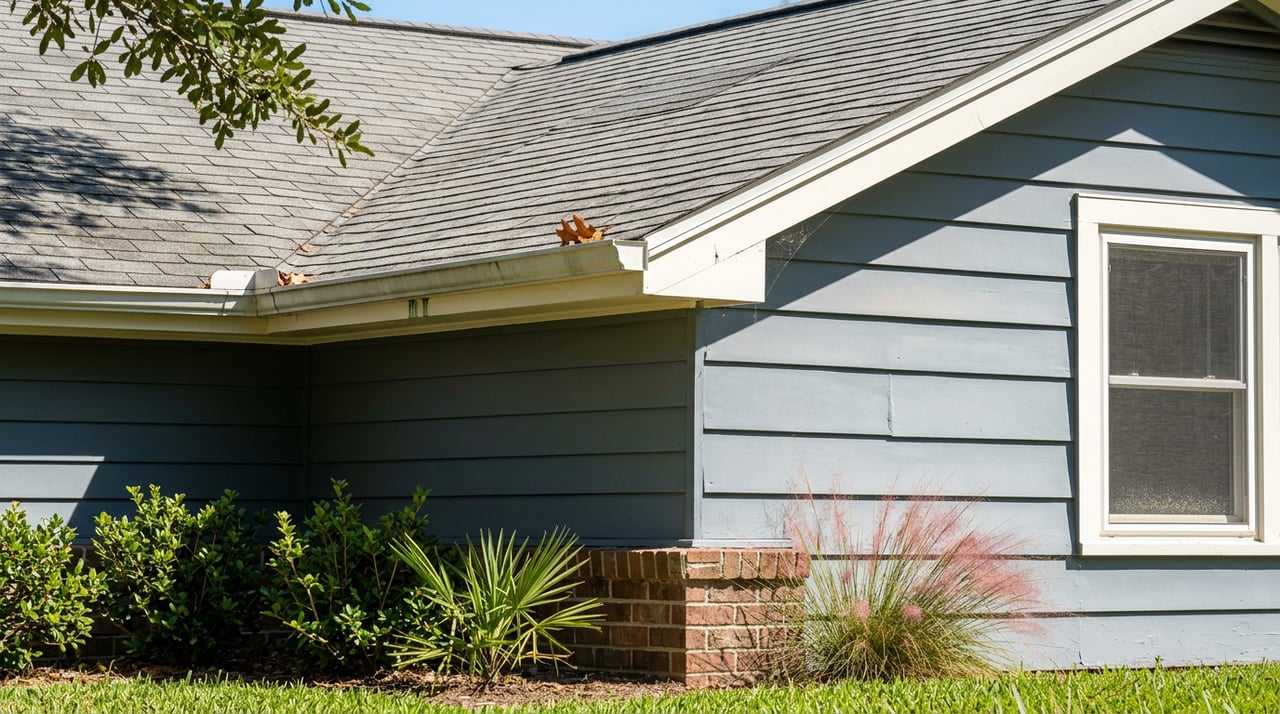
Roof age changes your coverage in a way many buyers don't discover until they're reading the actual policy language. Once a roof passes the five-year mark, some carriers switch roof coverage from full replacement cost to actual cash value, meaning a claim pays out the depreciated worth of an aging roof, not what it would cost to install a new one. A newer roof, or a properly documented replacement, can restore full replacement cost coverage or unlock a different carrier entirely.
Then there's the hurricane deductible, which is calculated as a percentage of the insured value rather than a flat dollar figure, typically 2% to 5%. On a $200,000 insured home, a 5% hurricane deductible means $10,000 out of pocket before coverage kicks in on a named storm claim. That's a number worth knowing before you sign, not after a storm.
The FORTIFIED math that can change your negotiation
Here's the part of this story that most guides miss entirely, and it's the reason this is worth reading past the rate table. Louisiana has spent the last few years building a genuinely useful set of incentives around the IBHS FORTIFIED roof standard, a stricter construction spec involving sealed roof decks and enhanced fastening designed to reduce wind and water intrusion.
There are three separate paths, and they stack:
- The Louisiana Fortify Homes Program grant, up to $10,000 toward a qualifying roof upgrade. It's a lottery, not first-come-first-served, and a special round in the fall of 2025 named Lake Charles, Sulphur, and Westlake specifically among the eligible areas alongside the state's Coastal Zone. The 2026 statewide round opened June 1 and closed June 19, distributing 3,000 grants on $80 million in funding, with an additional $50 million added in May 2026 that's expected to fund roughly 5,000 more.
- A state income tax credit, reimbursing up to $10,000 for FORTIFIED roof work completed on or after July 1, 2025. Anyone in the state can use it, whether or not they win the grant lottery, though you can't claim both on the same roof.
- Regulation 136, a Department of Insurance rule finalized in April 2026 that requires every property insurer in the state to apply a mandatory discount to the hurricane portion of a premium once a home carries FORTIFIED certification, ranging from 16% to 49% depending on the zone and certification level. The rule tracks the coast as higher risk, which means south Louisiana parishes, Calcasieu included, are positioned for the larger end of that discount range. It applies to any policy issued or renewed on or after January 1, 2027.
That timeline matters for anyone selling in Lake Charles over the next year. A seller who replaces an aging roof to FORTIFIED spec before listing isn't just making the house more attractive. They're handing the next buyer a documented path to a lower insurance quote and a policy that's easier to write in the first place, since a FORTIFIED certificate can transfer to a new owner at closing. In a market where insurability, not just price, decides whether a deal closes, that's a real negotiating asset.
What to check before your option period ends
If you're under contract in Lake Charles right now, a few questions are worth asking on day one rather than day twenty:
- Request an insurance quote as soon as the contract is signed, not after inspections. If a carrier declines to write the policy, you want to know while you still have time to shop or renegotiate.
- Ask the seller directly whether the current policy is with Louisiana Citizens, and whether the home has received a depopulation notice tied to Round 24's planned December 1, 2026 assumption date.
- Get the roof's actual age and any documentation of replacement or repair. If it's near or past five years, ask whether your quote assumes replacement cost or actual cash value.
- Ask whether the roof carries FORTIFIED certification. If so, confirm in writing that it transfers to you at closing.
- Get the hurricane deductible stated in dollars, calculated against the home's insured value, not just as a percentage.
What this means if you're selling
If you're listing a home with a roof approaching or past ten years old, the math has shifted in your favor for making a move before you list rather than after. The tax credit doesn't require winning a lottery. Neither does the mandatory Regulation 136 discount once the roof is certified. Framing a pre-listing roof upgrade around insurability, not just curb appeal, gives your buyer's lender and insurance agent one less reason to slow the file down.
A few questions worth answering directly
Does a standard homeowners policy in Lake Charles cover flood damage? No. Flood coverage is separate from a standard homeowners policy and typically comes through the National Flood Insurance Program or a private flood carrier. Mortgage lenders in flood-prone areas often require it as a condition of the loan.
What happens if my preferred carrier won't write a policy on the house I'm under contract for? Shop the independent market immediately and loop in your lender about the timeline, since a delayed insurance binder can push back your closing date. Louisiana Citizens remains available as a backstop for homes that private carriers decline, though its rates run at least 10% above the private market rate by law, a surcharge currently suspended for a three-year window.
Can I combine the FORTIFIED grant and the tax credit on the same roof? No. You can use one or the other, not both, on a single roof replacement. The Regulation 136 premium discount applies separately regardless of which path you used to get certified.
Insurance isn't a side detail in a Lake Charles home purchase. It's often the thing that decides whether the deal happens on schedule. If you're weighing a purchase or a listing here and want a read on how a specific roof, zip code, or timeline lines up with what carriers are actually writing right now, Reign Realty can walk through it with you before you're staring down an option period deadline. Work With Us.